
Specifically: letterheads, billheads, trade cards, lithographs, posters, stationery, labels, advertisements. The printed ephemera of the 1850s through the 1940s, the stuff that was meant to be thrown away and somehow wasn’t. We curate it, restore it, research it, and bring it back as artwork that can be appreciated today. Because they don’t make ’em like that any more.
Most of this art was made by master engravers and lithographers working with steel plates and stone, by hand, in workshops that no longer exist. All of it is genuinely beautiful. Almost none of it gets remembered or even found.
The story is the point.
A 1907 letterhead from L.C. Smith & Bros. has a heraldic crest, two rearing horses, and the words “Writing in Sight.” It’s gorgeous on its own. But it gets more interesting when you know that L.C. Smith made shotguns before he made typewriters, that his brothers ran the company after a falling-out, and that “Writing in Sight” was a literal feature. Early typewriters hid the page from the typist, and theirs didn’t.
That’s what we’re after. Not just the image. The story behind the image. Every piece we put out comes with the research. Who made it, when, why it mattered, what was happening in the world the day someone signed it.
Old hands, new tools.
We use modern restoration software the way a conservator uses a soft brush. Cleaning decades of wear, lifting stains, recovering line work that almost didn’t survive. The art was made by hand a century ago. Our job is to get out of its way.
Nothing here is generated. Nothing is “inspired by.” Every image started as a real object. Paper, ink, time.
Two ways in.
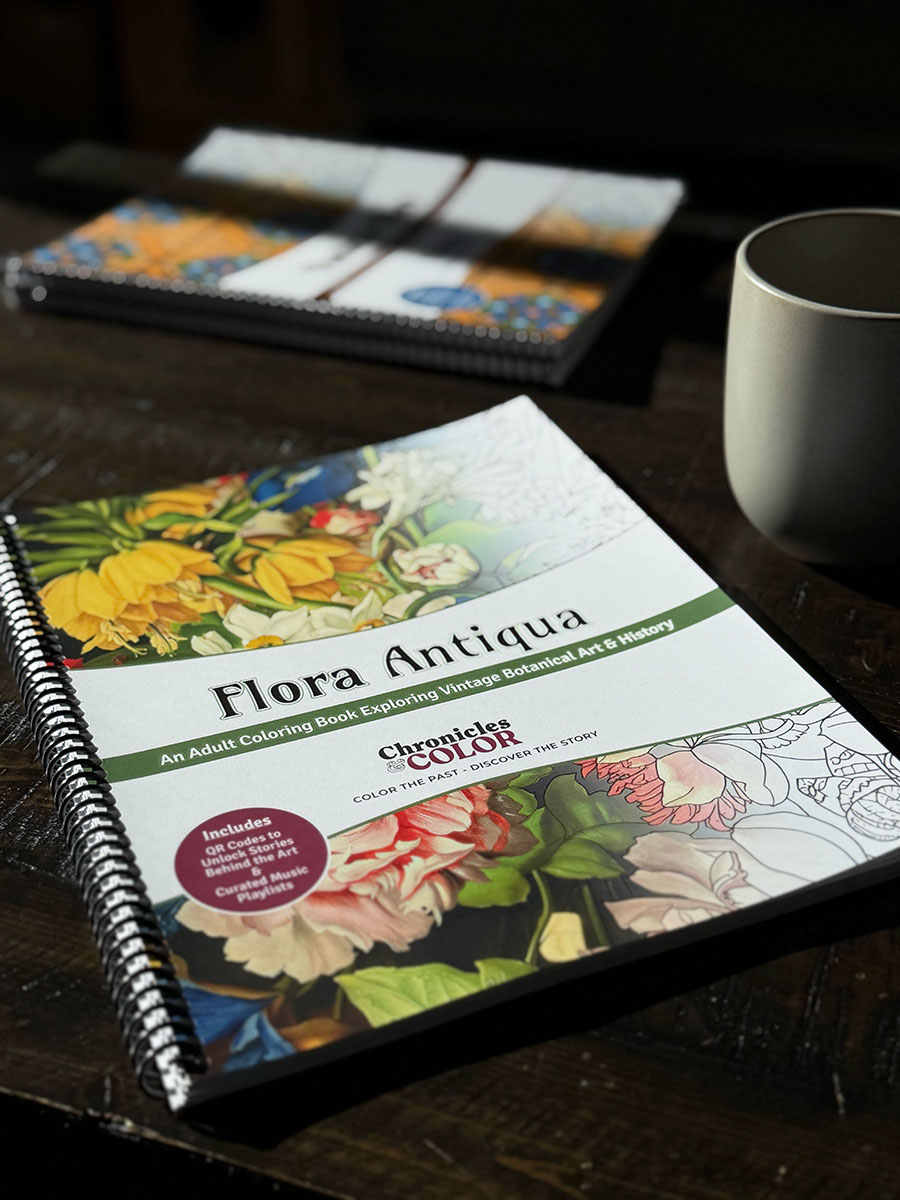
Framed prints, restored from the original ephemera and presented at the scale of fine art, with a companion postcard you can scan to hear a narrated audio history. Coloring books built from similar ephemera, because coloring in the lines by hand is the closest you get to the people who created the art. Both come with the full story. Who made it, when, why it mattered, what was happening in the world around it.
Scripta manent.
Scripta manent. Written words remain. The Romans had the full proverb. Verba volant, scripta manent. Spoken words fly, written words stay. Two thousand years later, we took it as a working principle. Find what remains. Restore it. Keep it found.